
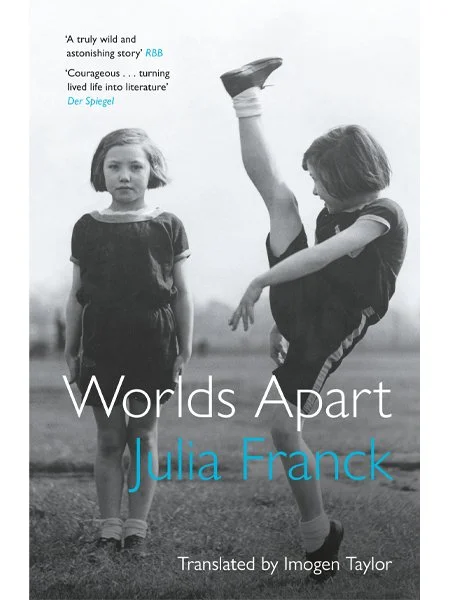
Worlds Apart
Born in East Berlin, Julia is eight when her actress mother uproots her family of four girls, by different fathers, heading West in search of a better life. Their eventual landing in the remote countryside of Schleswig-Holstein solves no problems for this fractured household.
Desperate to escape a childhood of rural poverty, neglect and shame, the lonely child becomes addicted to writing. Aged 13, she leaves her family. At school in West Berlin, she finally encounters love. In this gripping novel based on her youthful diaries and early life, Julia Franck shows why and how a great writer found her voice.
This ‘astonishing chronicle of recent German history’ (Julia Pascal), ’seamlessly translated’ by Imogen Taylor has been described by historian and journalist Katja Hoyer as ‘one of those books that involves you both intellectually and emotionally.’ It is ‘one of the most bizarre life stories I have ever come across’ yet also ‘moments of humour, curiosity and desire surface. At times I laughed out loud ...'
Julia Franck’s powerful novels of family and motherhood delve deep into the nation’s tumultuous past. Her work has won numerous prizes; her novel Blind Side of the Heart won the German Book Prize 2007, was translated into over 40 languages, filmed and has sold over a million copies in Germany alone. She lives in Berlin.




REVIEWS
-
— Katja Hoyer, journalist and author of Beyond the Wall and Weimar:
“It’s one of the most bizarre life stories I have ever come across, but also one that’s remarkably closely intertwined with the strands of German history.
“This is one of those books that involves you both intellectually and emotionally .. Franck’s story, fractured and often unsettling, mirrors the emotional and psychological mess of Germany’s twentieth century in striking and revealing ways. The book’s themes of family, inheritence and the reverberating impact of history on individuals will resonate far beyond a German context.
"Despite its difficult subject matter, the book is not without warmth or lightness. Franck allows moments of humour, curiosity and desire to surface. At times, I laughed out loud, such as when she describes herself and her twin getting up to no good, adding that the sisters, of course, sometimes have qualms about their misdeeds – just rarely at the same time.
“Ultimately, Worlds Apart is compelling because it shows how a single life can illuminate a broader historical reality. Franck’s story is unusual, even wild and extreme, yet it feels recognisable in its exploration of trauma, displacement and the search for belonging. In tracing the fault lines of her own past, she reveals how deeply personal lives remain entangled with history long after the events themselves have passed.”
-
— Declan O’Driscoll, The Irish Times
"A powerless Jewish child, forced to respond to the whims of adults, is the focus of Worlds Apart by Julia Franck, translated from the German, with considerable verve, by Imogen Taylor.
"Although it is classified as a novel, with the author emphasising the subjectivity of all authors in a preface, this is really a memoir. However it might be classified, it is a fascinating and well-told story about the narrator, Julia’s chaotic East German upbringing, in which all the usual expectations are reversed within her family, to the extent that Julia is secretive and embarrassed when she achieves the highest possible grades in her final year exams: “My mother, who was deeply suspicious of any form of achievement, disapproved of high achievers on principle."
"By the end of this well-crafted Bildungsroman, the most astounding realisation is that, despite all the privations and negligence a person might suffer, love can still survive."
-
— Julia Pascal, London Grip
"This memoir is an astonishing chronicle of recent German history seen through the eyes of a girl born in the East and brought up in the West. This is a landscape where Nazi, post-Nazi, Communist and post-Communist worlds elide.
”The most striking parts of the story are when Franck shares the misery of the daily routine of maternal abandonment. The picture she gives us of the mother’s preoccupation with her own desires for sex, cigarettes and alcohol, and her inability to nourish or clothe her children, is compelling. The road from bourgeois respectability to anti-bourgeois defiance is realised with an acuity that makes this book hard to put down.
"Overall Franck is served well by Imogen Taylor’s translation which is seamless. It conveys the original German in a natural and original English."
-
— Tina, TripFiction
"This is a captivating trawl through generations of one family that offers a valuable insight into political and historical events that shaped the world, all seen largely through the prism of the female members’ lives.
"It is quite a big book, in terms of both themes and structure, and is certainly an insightful read for any Germanophile who wants to get under the skin of the country. This has been well translated by Imogen Taylor, who offers an interesting insight into her endeavours at the end of the book."
-
— Interview by Sheridan Marshall, New Books in German
"Much of Franck’s work is concerned with the interplay between personal and collective history. Themes such as the ruptures of twentieth-century Germany, the enduring impact of war and division, the fragility of family bonds and the complexities of motherhood recur throughout her oeuvre. Her elegant prose is characterised by its emotional intensity and unflinching honesty.
"In her auto-fictional novel, Worlds Apart, Franck returns to the landscape of her own childhood to tell the gripping story of a family fractured by political upheaval, migration and internal turmoil. Moving from East to West Germany, the narrative charts the formation of a young girl’s identity under extraordinary pressure, tracing the early development of a future writer navigating experiences that verge on the unbearable. At once intimate and far-reaching, Worlds Apart illuminates both a singular life and the broader history of a divided nation."
-
— The Jewish Chronicle
"Worlds Apart is clearly Franck’s story, although as she notes in the foreword, “no real person will recognise themselves in any of the characters”. Indeed, when the Julia in the book is barely a teenager and finds a way to extricate herself from her situation, the character becomes “the girl”. Perhaps this distance is partly what enables Franck to dig into these memories. Her late teens, while more ordered, see her moving between host families and then eventually to dubious accommodation in the city’s red-light district. But she meets a middle-class boy, Stephan, and falls utterly, wonderfully in love. Yet we know from the outset that this too will end in the worst possible way. Some things are clearly too painful for Franck to dredge up. Is Anna mentally unwell, or simply unsuited to mothering? It is never interrogated. But what this book brings to life is just how formative a terrible childhood can be.
"So, misery. But beautifully written and translated, by an author desperate to make sense of her roots. “How is the wilderness of a person’s origins to be mapped?” writes Franck. After all she has endured, I hope writing this has helped her find an answer.”
-
— Rosie Goldsmith, Riveting Reviews
"We’ve waited for ten years for this major, prize-winning, internationally admired author to write something new. And here we have it, in a beautiful translation from Imogen Taylor. The genius of Julia’s page-turning, circular style in Worlds Apart is that everything feels authentic and alive. In a short preface the author writes:
Our stories, our perceptions, are often worlds apart. We remember events and loved ones differently … That is why no real person will recognise themselves in any one of the characters in this book. They can’t.
"What is real and undeniable is the turmoil of history, a constant character in the novel, as everyone in it is shaped and influenced by World War Two, antisemitism, the holocaust, the division of Germany, surveillance, Nazis, Stasi, and, in 1989, the fall of the Berlin Wall, reunification and a kind of freedom. Julia’s life is rocked by German history, and reflected in it. No wonder she almost crumbles. This deeply impressive novel is, amongst many things, a moving depiction of psychological damage and resilience.
"The novel itself is not framed chronologically but is written in what I can best describe as “crafted free association”. It is quite thrilling to read.
"Today Julia Franck is a successful, lauded and awarded author, known across the world, settled in Berlin with two grown-up children. Worlds Apart is the story of a life, her life, of the many lives in her family. It is a record. I can understand her desire to set it all down, to make some sense of her own real life, as opposed to the literary life of a novelist. Through all this the act of writing has been her constant and her refuge.
"If I’m indulgently and liberally quoting from Worlds Apart, it is because it is such a pleasure to read, with enormous credit to the magical touch of translator Imogen Taylor. (Do read her translator’s essay at the end of the novel.) Worlds Apart reflects my own lifespan and describes a country and language I know well, and I found myself scribbling down long passages as aids to my own memories of that time.
"Thank goodness Julia Franck overcame her misgivings in order to confront her story and to share it with us in this sumptuous, unforgettable narrative."
-
— Berliner Zeitung
"Radically personal .. a stirring book in prose that captivates and engages”
-
— Süddeutsche Zeitung
"Worlds Apart depicts not just life, but memory itself”
-
— TAZ
"This family history hinges like a swinging door on key dates in twentieth-century German dictatorship … the novel finds life in a new territory between worlds that Germans don’t often talk about”
-
— Die Zeit
“Julia Franck has found a way of building on her great success and continuing her life’s work”